First Writing Project Revision with Evidence
When revisiting my early work in relation to Doyle and Konnikova, I can see drastic differences in not only my writing responses but also my reading and annotation skills as a whole. First, looking at my annotations from “The Hawk” by Brian Doyle, there isn’t much purpose to what I’m doing. It almost looks as if I’m just marking up the text to get something on it. There is no method or reasoning to the areas of annotation. This style is very similar to the one I was taught in high school, where there isn’t really a method to the madness. On a different note, when looking at my annotations from Maria Konnikova’s essay “The Limits of Friendship,” just a week or so later, the annotations are much more sophisticated. I have to give credit to the Brief Guide to Annotations; this guide has helped me further develop my marginal notes. For example, if you observe the annotations from the first paragraphs of both texts, you will see a lot more going on in Konnikova’s essay than would Doyle’s. We can see this in the comparison below:
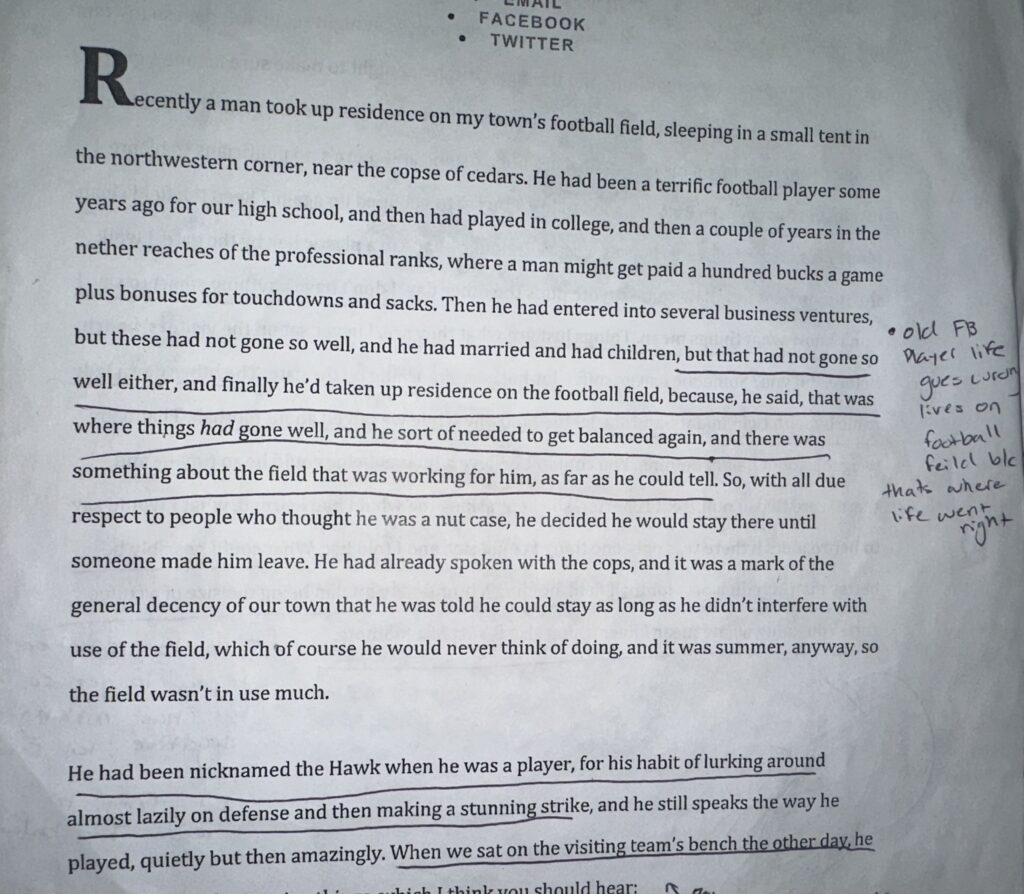
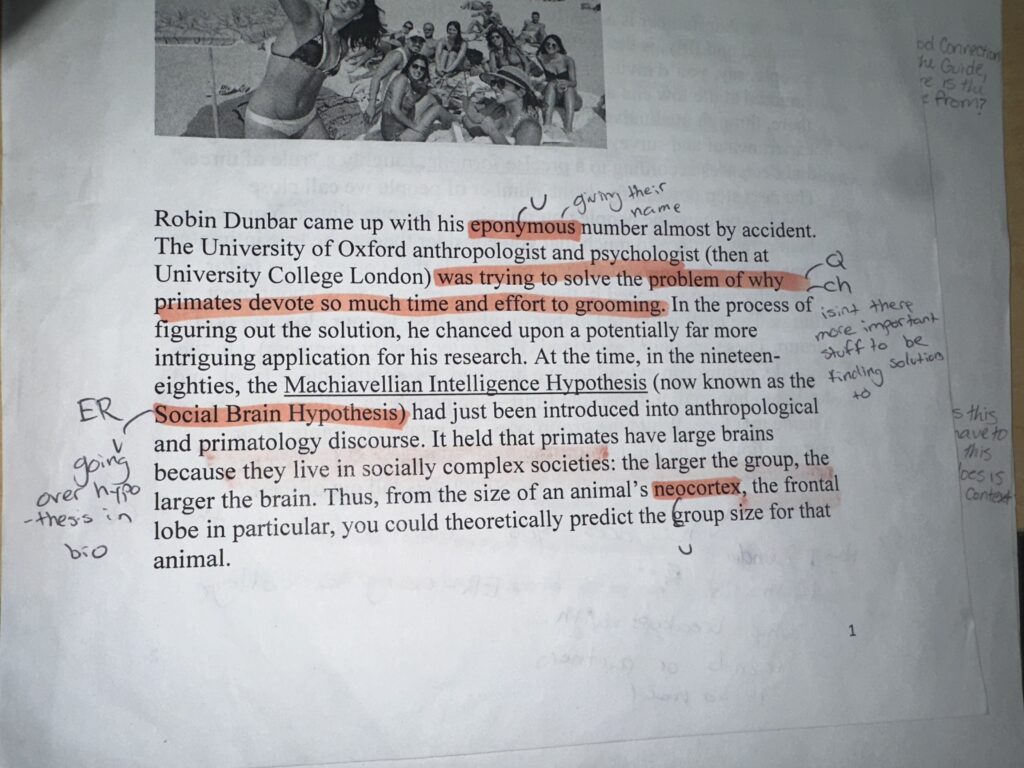
Comparison of the first paragraph annotation from Doyle and Konnikova
Moreover, in the first paragraph of Doyle’s text, I have about one sentence underlined, with no specific reason listed, and a bullet point off to the side summarising what I just read in very vague terms. However, if you look at the first passage in Konnikova’s piece, it is a completely different story. There is highlighting, underlining, arrows, questions in the margins, challenges against the author’s statements, and actively defining unknown words. I am also actively making connections from the text to my own personal life. We can see this when Konnikova starts to explain Robin Dunbar’s theories and hypotheses. I go on to connect the “Machiavellian Intelligence Hypothesis now known as the Social Brain Hypothesis…” to my own personal experience in my first semester biology course (Konnikova 1). This illustrates more active and engaged reading by connecting the text to broader topics within my life. Overall, just by comparing the first two paragraphs from those pieces, you can see my understanding of annotations drastically improving and gaining complexity.
Furthermore, I would say my reading responses have remained relatively consistent despite one difference. I am integrating myself into my responses more. Looking at my first reading response from “The Hawk,” I go pretty in depth, use examples, and connect things to the broader world. However, if you look at my reading responses to the “Limits of Friendship” questions instead of taking examples from the text, I focus more on connecting the text to myself. In question three of that assignment, when asked to give an example of the Dunbar method in my own words, I described it as “the max amount of people historically our brain can handle maintaining relationships with”, and then went on to explain the different intimacy levels of those numbers and people. The only change in this response is the fact that I end it by bringing in my own personal connection to my mom. I state, “[t]hroughout my childhood I always had a good relationship with my mom, but as I got older I started to rely on her more aggressively. She became my best friend and the person I tell everything to. My mom migrated from being in my close fifteen to my number one, our relationship is an example of how these layers of social circles can naturally change over time”. My first reading response, while I did connect it to the broader world around us, I didn’t connect it back to something specific and personal in relation to the text, showing growth over the first couple of weeks.

Excerpt from Limits of Friendship reading response
Finally, when comparing annotations and reading responses from the past few weeks, I feel my source integration has remained pretty consistent. Looking them over, I could develop my quote sandwiching specifically in my responses. An example of quote sandwiching I have done can be found in my reading response to Limits of Friendship, where I introduce the quote, give a full quote, then cite and analyze it to support my claim.

Example of quote integration from the Limits of Friendship reading response
However, I find it harder to introduce and explain quotes within a shorter written response than in an essay such as this one. I tend to either introduce the quote too early or not implement a quote where there should be one to further connect my point. In addition, I can also improve on previewing the texts before reading them. Previewing was not a skill I was taught in high school, and, as a reader, I acknowledge that I get impatient and sometimes don’t want to take the time to preview the author, date, and other additions to the text before diving in. While I note who the author is, I don’t take the time, unless prompted, to go and research the author, their credentials, and history that prove they are a person I should take seriously. I acknowledge the impact previewing has, because when I took the time to research who Maria Konnikova was and her life story before rereading the text, I felt more connected and engaged with the reading the second time. Overall, previewing and source integration are my areas of ongoing growth and improvement throughout my reading and responses, and something I will be more cognizant of moving forward this semester.
