EPortfolio Final Project
- Revision
When I look back on my idea of what revision is over the course of the semester I notice a lot of changes. Going into college I always thought of revisions as little picture stuff. Going through sentence by sentence and making sure every period, comma, and word is integrated correctly. Often I found revision a tedious task that was boring. As I’ve gone through this writing course I have grown to understand that revisions is not the tiny stuff but the bigger picture items in your writing like structure, ideas, source integration, voice. I feel as a writer I have improved the most in including my own voice in my writing, specifically when revising I have learned to focus on my “I say” “They say” balance to create an essay that flows through topics and points while also making structural sense. I enjoy revising with multiple perspectives of readers being a peer and Professor Bro . Having a lot of eyes on my paper helps me understand what is a big point of revision and what are somethings that are less of an issue. An example of my revision can be seen below when I take a margin comment from Professor Brod about incorporating Zadie Smith and Ross Gay into my introduction for my Joy essay. Below I have the before picture of my introduction including a lot of personal voice and imagery but is lacking a lot of the “They say” components. You can then see in the next picture is a revised paragraph where I have introduced and integrated both authors into the paragraph so that when I put them in conversation with one another in future paragraphs it makes more sense to the reader. I have chosen these because I feel it shows my understanding of revision, I take the feedback, and fix the bigger picture item to improve my structure and point.


I have chosen these because I feel it shows my understanding of revision. I take the feedback about my introduction regarding text integration and structure, and fix the bigger picture item by implementing both my main authors into my introduction to improve my structure and point. This will ultimately help my reader better understand my essay as they continue to read because they have a background as to who the two authors are.
Moreover, another example of me embracing the revision process can be seen in the introduction of my Empathy essay.Despite not having the before and after picture of this paragraph I did a long list of revisions on this introduction and it took me a long time to get this part of my essay to a place I was comfortable in. In class we went over my introduction and I took both the positives and negatives of that conversation to create an introduction I was proud of in the long run. I was able to narrow down my ideas, create an introduction that made sense, and build off of my peers’ feedback.
- Integrating Ideas
Overall my source integration from this semester has improved. Coming into this semester I really only knew how to do full quotes with confidence and maybe if I was feeling lucky I’d throw in a partial quote. Even when I was using these integration styles I could never integrate them into my writing smoothly in a way that flowed with the ideas of the paragraph. As the semester has progressed I have developed ways of integrating sources I didn’t know were possible. For example, I have enjoyed integrating paraphrasing into my essays and reading responses more. I feel it is an easy way to use the author’s ideas and incorporate your voice at the same time without the choppiness of quotes, when used right. Paraphrasing has allowed me to be a bit more free with my responses rather than focusing on exact quotes. However, I find that now I have a better understanding of how to properly integrate full and partial quotes into essays without disrupting the flow after this semester. Furthermore, I have gotten better at using my own voice within my writing and connecting my own experiences to my quotes to create powerful paragraphs and messages within my writing to strengthen my points and arguments. Barcley paragraphs have been one of my favorite writing tools I have learned and I find they help get my ideas across and create thoughtful connections between my ideas and text to text.


If you look above you will see a well formed barcley paragraph with voice and sources working in tandem with each other to help further my argument. In this Barkey paragraph from my Joy essay I create a conversation between Ross Gay and Brian Doyles and use this to help get my point across to my reader. I also add in some “I say” components as I put in some personal experiences as hypotheticals to strengthen the connection between the two texts and integrate the ideas better. Another Barkley paragraph I am proud of is from my Empathy essay. In this paragraph I compare Bloom’s ideas of empathy to Brian Doyle’s essay The Hawk to ultimately support my thesis that empathy is a choice and can make impactful change. This paragraph is another example of me integrating two sources within my writing to create a sustainable argument.
- Reading and annotations
When comparing my reading responses from the start of the year to the end I can see a lot of my voice and personal opinion in my responses rather than just restating the text or what the author says. You can see this change in the comparison of one of my earlier responses to a reading regarding one of Brian Doyle’s pieces.


Although in the first response I bring up personal experience, in the second response to Doyle I connect to personal experiences, but I also analyze what the author is trying to say in my own personal interpretation. I interpret a message from the reading rather than just restating or summarising what is being said. In my more recent responses I go from just interpreting the text to analyzing it and thinking of the broader and bigger picture regarding the text. I begin to really focus on the author’s message rather than literal words on the page. Furthermore, you can see the change in my annotations from my first time in The Hawk compared to my annotations in Ross Gays essay.
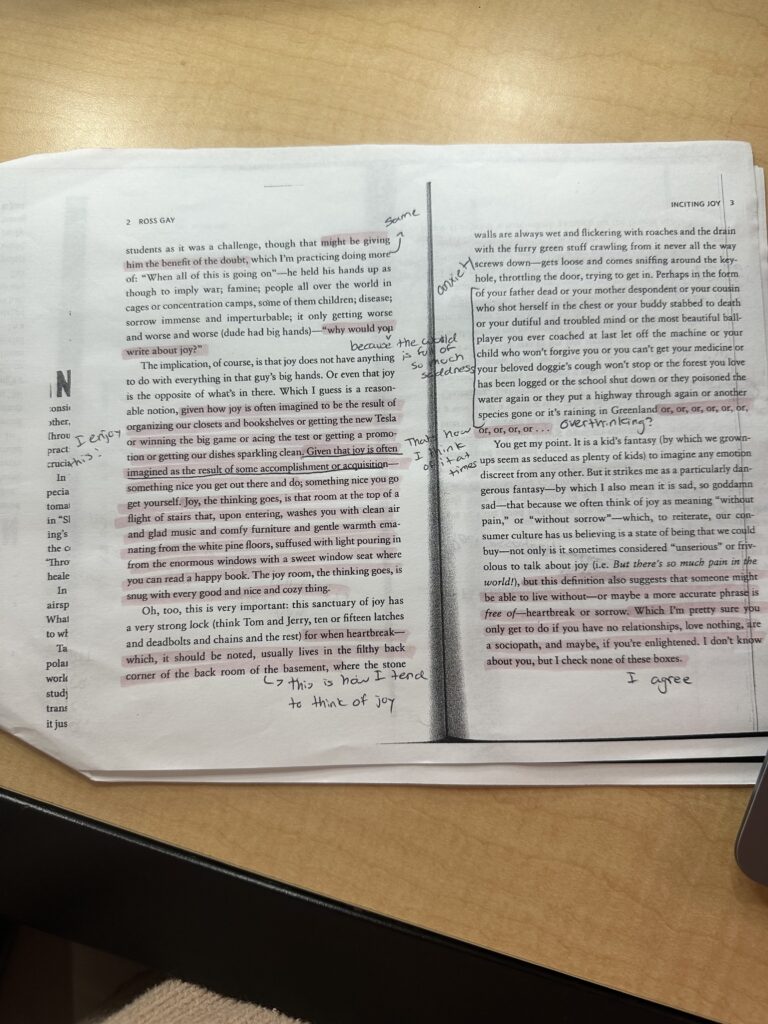
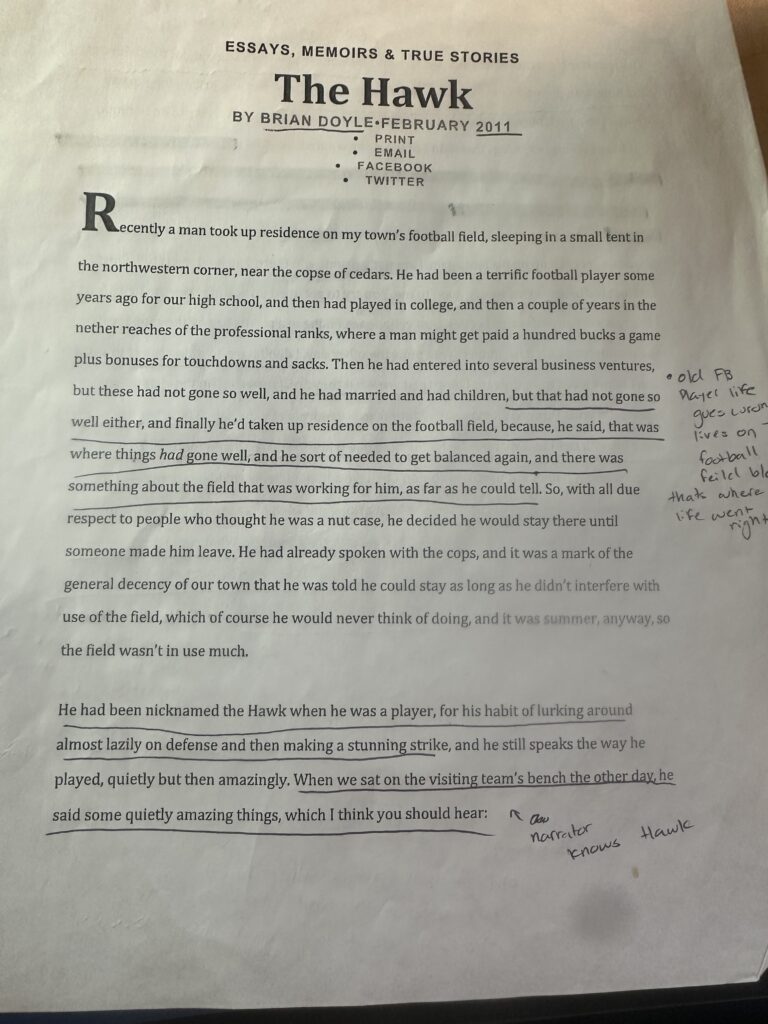
In the Hawk by Brian Doyle I do a lot of random underlining and summarising. I don’t really have a clear strategy with my annotations. However, when you look at my annotating in Gays peice I am asking questions, connecting to my own life, highlighting and underlining more intentionally, and making marginal comments that will help me in my essay. This style of annotations also helped me bring things to the next class period that I have questions about, things I want defined, or a concept that I want to expand on. My annotations have become alot more purposeful and organized to help me as a writer later when using the text as sources to prove a point.
- Peer Review
My idea of peer review in high school was to come into class with an essay. Match with a friend and give them your essay where they mark up grammatical errors and sentence structure issues to the best of their ability. They then tell you you did a good job and send you on your way by the end of class. However, my idea of peer review has changed drastically after taking First Year Writing. I now understand that peer reviewing is not the process of solely checking someone’s grammar but rather reading someone’s piece and analyzing how it makes you feel as a reader. Does it make sense? Does it flow? Do you understand their argument? When I look back on my peer review from the start of the semester I feel it was strong because I had an outline of what I should be looking for, which I didn’t have in highschool, and I was coming at it from the perspective of a reader not a friend. I enjoy the structure of marginal comments, and end comments where you can summarize your thoughts and help your peers actually understand what you are trying to convey as a reader so they can improve their writing. Below you will see an end comment I have left on one of my peers writing after reviewing it. You will then see two marginal comments I left for my peer that I feel were strong and helpful feedback.


Finally you will see a comment left for me with feedback regarding the start of my paragraph.


As a reader Emma was expressing that she feels it would be better if I started the paragraph below with a claim sentence. You can see the before and after of when I go in and create a claim sentence regarding my claim and what this paragraph is showing before going into my personal interview. This is an example of me incorporating my peers’ feedback into my writing after peer review.
